UX audit: understand what is wrong before redesigning
A process for separating real problems, symptoms and preferences, then turning them into testable design priorities.
Published · 4 September 2026Updated · 4 September 2026
00 · Premise
A redesign is not the starting point.
Changing an interface without understanding where and why the experience breaks can simply move the problem. An audit connects evidence, journeys, content and constraints before proposing solutions.
An audit for making decisions
Observe, reconstruct, prioritise and verify.
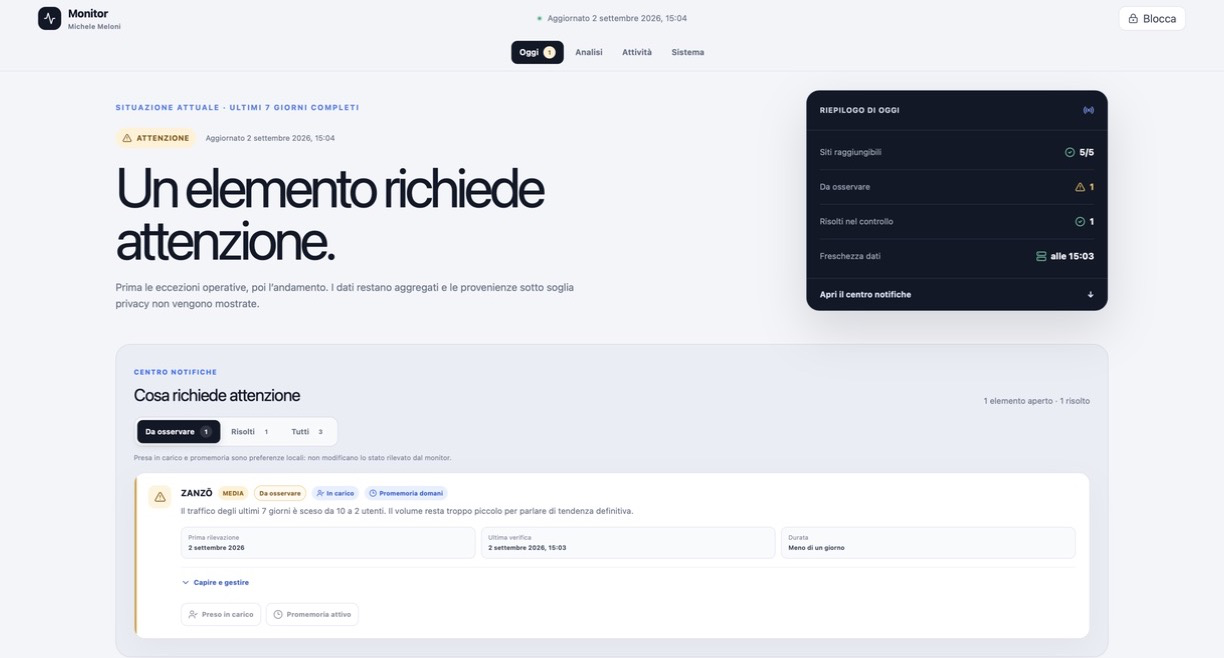
In the Website monitoring project, the daily view separates real issues, completed checks and data that still requires verification. The same discipline improves an audit: not every anomaly has the same weight or certainty.
- 01Observe
Gather evidence from usage, data and support.
- 02Reconstruct
Connect problems to the steps in the journey.
- 03Prioritise
Assess impact, frequency and risk.
- 04Verify
Check assumptions with users and teams.
Define the scope
Clarify which users, tasks and channels belong in the audit. A scope that is too broad creates an inventory; a focused one supports decisions.
Practical actions
- Identify the most important tasks.
- Select the journeys and devices to examine.
- State constraints and open questions.
Combine different sources
Analytics, support, interviews, testing and heuristic review reveal different parts of the same problem. Strong findings emerge when multiple signals converge.
Practical actions
- Separate observed data from interpretation.
- Connect every finding to a source.
- Highlight contradictions and missing information.
Describe the problem without designing the answer
A useful finding explains who encounters the problem, where it happens, what the consequence is and how well the evidence supports it.
Practical actions
- Use one consistent format for every finding.
- Avoid judgements such as “ugly” or “outdated”.
- Separate severity, frequency and confidence.
Turn findings into a roadmap
Group common causes and dependencies. Some problems need a local fix; others involve content, process or technology. Not everything requires a redesign.
Practical actions
- Prioritise impact against effort.
- Define quick and structural interventions.
- Give every action a verification criterion.
Ready to use
What a good audit should leave behind
- Scope, audience and priority tasks.
- Findings connected to recognisable evidence.
- Severity, frequency and confidence.
- Common causes separated from symptoms.
- A roadmap with ownership and verification criteria.
Key principle
An audit should enable decisions, not produce a list.
Its value is making clear what to change, why, in which order and how the team will know whether the experience improved.