Designing complex forms: fewer errors, better completion
A method for turning questions, dependencies and validation into an understandable, recoverable journey that follows the person’s decisions.
Published · 5 September 2026Updated · 5 September 2026
00 · Premise
A complex form is a service, not a sequence of fields.
Quotes, applications and configurations become fragile when internal logic is poured directly into the interface. Design must translate rules and dependencies into a conversation: ask only what is needed, explain why and preserve work when something goes wrong.
Flow architecture
Decision logic comes before fields.
In Allianz Fast Quote Casa, the journey was treated as a system of steps, checks and returns. Visualising the complete structure separated the primary path from exceptions before layout decisions were made.
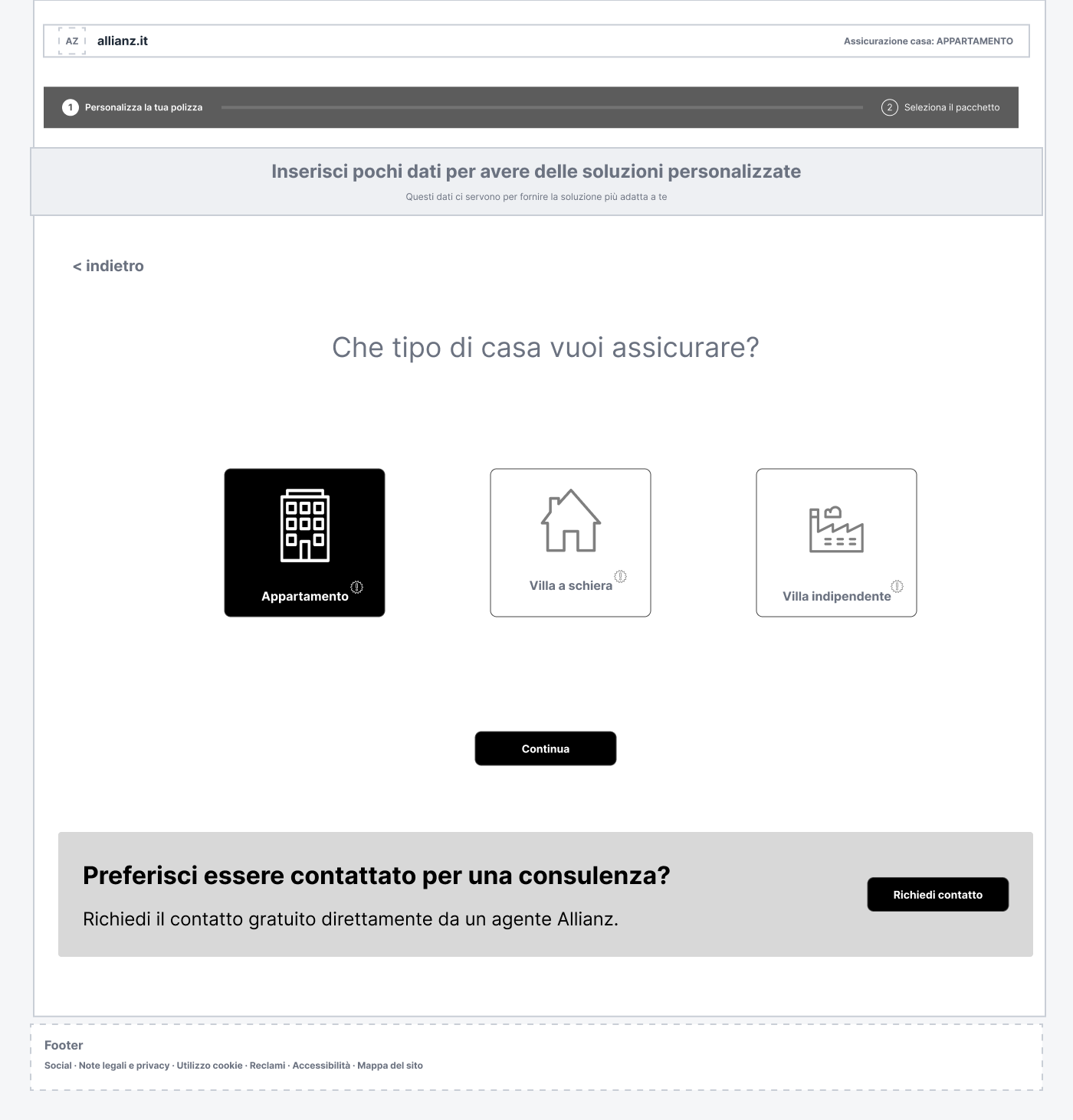
Start from the outcome, not the fields
Define what someone needs to achieve and which information is genuinely required. Every question without a recognisable consequence adds friction and doubt.
Practical actions
- Connect each field to a decision or requirement.
- Remove requests that are redundant or recoverable from existing data.
- Explain the use of sensitive or unexpected information.
Build groups with visible logic
Group questions around the person’s mental model rather than departments or databases. Headings, progression and summaries should make the journey recognisable.
Practical actions
- Give every step a clear purpose.
- Show progress only when it helps estimate the effort.
- Keep the question, help, format and error together.
Validate at the right moment
Checking everything at the end forces people to hunt for errors; interrupting on every keystroke creates anxiety. Validate when a meaningful unit has been completed.
Practical actions
- Flag impossible formats immediately.
- Check completeness after the field or step is complete.
- Describe the problem and correction without technical codes.
Protect continuity and recovery
A long form must tolerate pauses, unstable connections and changed decisions. Preserving valid data and showing what remains reduces abandonment and repeated work.
Practical actions
- Keep information that has already been verified.
- Allow people to go back without losing data.
- Confirm submission, status and next steps precisely.
Ready to use
Complex-form preflight
- Every field has a verifiable purpose.
- Groups follow the person’s reasoning.
- Dependencies and exceptions do not overload the main path.
- Errors and instructions stay close to the item to fix.
- Valid work survives errors and returns.
- Confirmation and next steps are explicit.
Key principle
The best form makes deciding easy, not only filling in.
Quality emerges when service logic, content, validation and recovery form one journey. Fewer fields help; less uncertainty helps more.